
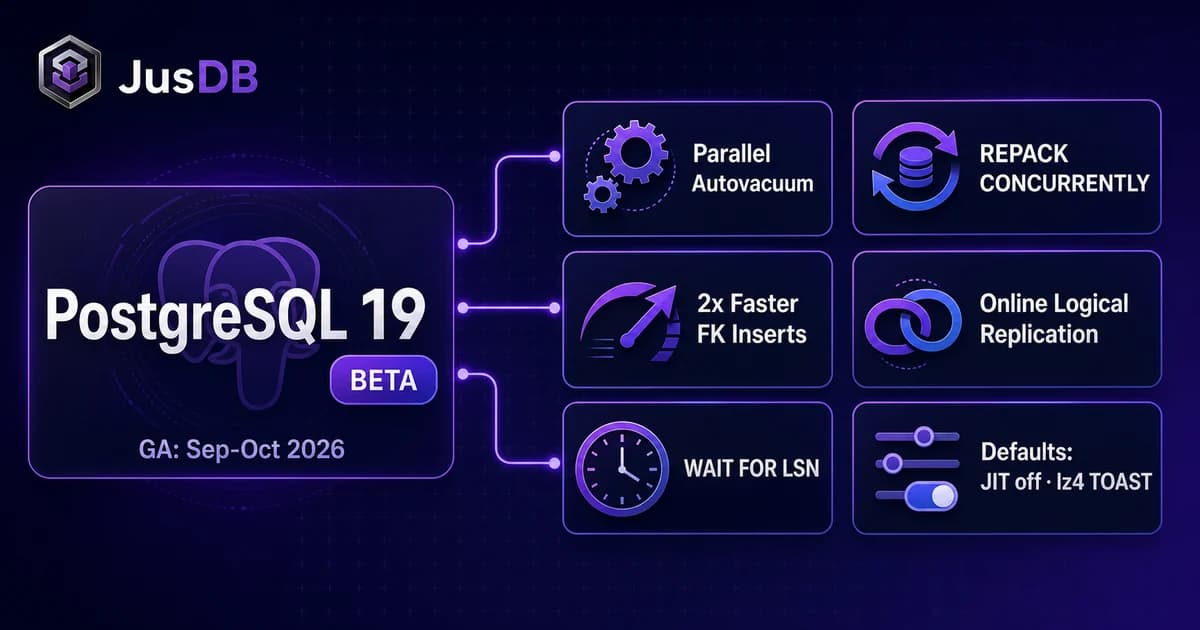
PostgreSQL 19 Beta 1 landed on June 4, 2026, and it is the most consequential release for operations teams since the asynchronous I/O subsystem debuted in PostgreSQL 18. With over 200 changes carried forward, PostgreSQL 19 is less about flashy syntax and more about the things DBAs fight with every week: vacuum that finally goes parallel, online table rewrites without a maintenance window, insert paths that are twice as fast under foreign-key load, and the ability to flip logical replication on without a restart. This guide walks through every feature that matters to people who run PostgreSQL in production — what changed, why it changed, and what you should actually test before general availability lands in September/October 2026.
PostgreSQL 19 Beta 1 is for testing only. Behaviors, catalog definitions, and APIs can still change before GA, and there is no upgrade path guarantee between betas. Test it against a copy of your real workload — not toy data — and report anything surprising to the Open Items list. Do not point production traffic at it.
- Parallel autovacuum — autovacuum workers can now parallelize index vacuuming via
autovacuum_max_parallel_workers, plus a new scoring system to prioritize the tables that need it most. - REPACK — a built-in, optionally non-blocking (
CONCURRENTLY) replacement forVACUUM FULLandpg_repackto rebuild bloated tables without an exclusive lock. - 2x faster inserts with foreign keys and improved
LISTEN/NOTIFYscalability. - Online logical replication — enable logical replication while
wal_level = replica, without restarting the server. - WAIT FOR LSN — a first-class command for read-your-writes consistency against replicas.
- Default changes that will surprise you: JIT is now off by default and TOAST compression defaults to
lz4. - RADIUS authentication is removed, and
md5auth keeps marching toward deprecation.
Vacuum Finally Goes Parallel
For years, the single most common "why is my big table slow to maintain" answer was that a single autovacuum worker chews through one table's indexes serially. PostgreSQL 19 changes that. Autovacuum can now run parallel workers, controlled by the new autovacuum_max_parallel_workers setting, so the index-vacuuming phase on large tables is spread across multiple processes the same way a manual VACUUM (PARALLEL n) already could.
Just as important is a new autovacuum scoring system that prioritizes which tables to vacuum first, instead of the older mostly-FIFO behavior. On a busy cluster with hundreds of tables and skewed write patterns, this means the table that is actually generating the most dead tuples and bloat gets attention before the launcher wanders off to a cold table that happened to cross its threshold.
PostgreSQL 18                          PostgreSQL 19
   ┌────────────────────────┐            ┌────────────────────────┐
   │  autovacuum worker      │            │  autovacuum worker      │
   │  ┌──────────────────┐   │            │  ┌──────────────────┐   │
   │  │ heap scan        │   │            │  │ heap scan        │   │
   │  ├──────────────────┤   │            │  ├──────────────────┤   │
   │  │ index 1 (serial) │   │            │  │ index 1 │ index 2 │   │ ← parallel
   │  │ index 2 (serial) │   │            │  │ index 3 │ index 4 │   │   workers
   │  │ index 3 (serial) │   │            │  └──────────────────┘   │
   │  └──────────────────┘   │            │  scored + prioritized   │
   └────────────────────────┘            └────────────────────────┘
        one table at a time                 hot tables first, indexes fan out
There is also a subtler win: a new vacuum strategy that can mark pages as all-visible while they are still being queried, which keeps the visibility map fresher and helps index-only scans stay fast on actively-read tables.
Take your largest, most-indexed table and compare autovacuum duration on 18 vs 19 with autovacuum_max_parallel_workers set above zero. Watch pg_stat_progress_vacuum — it now exposes a started_by column (who kicked it off) and a mode column (the vacuum operating mode), so you can finally tell a manual vacuum apart from an autovacuum-triggered one at a glance.
REPACK: Online Table Rebuilds Without the Extension
Bloat reclamation has always been the awkward part of running PostgreSQL. VACUUM FULL reclaims space but takes an ACCESS EXCLUSIVE lock — a hard outage for the table. The community answer has been the third-party pg_repack extension, which is excellent but is something you have to install, version-match, and trust outside of core.
PostgreSQL 19 introduces a native REPACK command, including a non-blocking CONCURRENTLY option that rebuilds a table to remove bloat while reads and writes keep flowing.
-- Rebuild a bloated table online, no exclusive lock held for the duration
REPACK orders CONCURRENTLY;

-- Rebuild and re-cluster by an index's order
REPACK orders USING INDEX orders_created_at_idx CONCURRENTLY;
Under the hood, REPACK ... CONCURRENTLY builds a fresh, bloat-free copy of the table while live traffic keeps hitting the original, captures the changes that happen during the rebuild, replays them onto the new copy, and finally swaps the two under a brief lock — the same pattern pg_repack pioneered, now baked into core:
REPACK orders CONCURRENTLY

   live reads + writes
          │
          ▼
   ┌───────────────┐        1. build copy        ┌───────────────┐
   │  orders       │ ─────────────────────────►  │  orders_new   │
   │  (bloated)    │        (no excl. lock)       │  (compact)    │
   └──────┬────────┘                             └──────┬────────┘
          │  2. capture concurrent changes              │
          │     into a change log ──────────────────────┤
          │                          3. replay changes  │
          │                                             ▼
          │                              ┌──────────────────────────┐
          └─────────────────────────────│ 4. brief lock → atomic    │
                                         │    swap orders ↔ orders_new│
                                         └──────────────────────────┘
                                                      │
                                                      ▼
                                          bloat reclaimed, lock held
                                          only for the final swap
For teams who have been carrying pg_repack as a dependency purely to avoid VACUUM FULL downtime, this is a meaningful simplification: one fewer extension to manage across every cluster, and a feature that the core project now tests and supports directly.
CONCURRENTLY trades the exclusive lock for extra I/O and disk — it builds a fresh copy of the table. Make sure you have headroom on the data volume before running it against a multi-hundred-GB table, and benchmark the runtime on a restore of production so you size the maintenance budget correctly.
The Insert and Notify Performance Wins
Two changes here will show up in real workloads without you touching a single setting:
- ~2x better performance on inserts when foreign key checks are present. Anyone bulk-loading into normalized schemas — order lines referencing orders, events referencing entities — has paid the FK-check tax on every row. PostgreSQL 19 roughly halves it.
- Improved
LISTEN/NOTIFYscalability for multi-channel workloads. Applications using PostgreSQL as a lightweight pub/sub bus across many channels hit contention in older versions; 19 relieves a lot of it.
The planner got attention too. PostgreSQL 19 adds anti-join optimizations, broader use of incremental sorts, a new enable_eager_aggregate option to push aggregation lower in the plan for faster row processing, and a quiet-but-nice simplification: IS DISTINCT FROM and IS NOT DISTINCT FROM collapse to plain <> and = when the planner can prove the inputs are not nullable, which unlocks index usage that the verbose form previously blocked.
Plan Stability: pg_plan_advice and pg_stash_advice
One of the longest-standing operational complaints about PostgreSQL is the lack of a clean, built-in way to pin a plan that suddenly regressed. PostgreSQL 19 ships two new extensions toward that goal:
pg_plan_advice— lets you capture and influence planner decisions to stabilize plans that the cost model gets wrong.pg_stash_advice— applies that advice automatically, keyed off query identifiers, so a known-good plan sticks without manual intervention on every execution.
This is not Oracle-style hints embedded in SQL, but it is the most serious in-core answer yet to "this query was fine yesterday and the planner flipped to a bad join order overnight."
Asynchronous I/O Grows Up
PostgreSQL 18 introduced the AIO subsystem. PostgreSQL 19 makes it operationally sane. With io_method = worker, the number of I/O workers now scales automatically between two new bounds:
# postgresql.conf
io_method = worker
io_min_workers = 1     # floor — always keep this many I/O workers
io_max_workers = 8     # ceiling — scale up to this under load
Instead of guessing a static worker count, the server expands and contracts the pool with demand. And when you profile a query, EXPLAIN ANALYZE now reports AIO statistics through the IO option, so you can actually see how much of a plan's time was spent waiting on asynchronous reads.
Operational Game-Changers for HA Teams
Online Logical Replication (No Restart)
Historically, enabling logical replication meant setting wal_level = logical and restarting the server — a planned outage on the primary. PostgreSQL 19 lets you enable logical replication online while wal_level is still set to replica, no restart required. A new read-only effective_wal_level parameter reports the WAL level actually in effect, so you can confirm what the server is really doing versus what the config file says.
PostgreSQL 18                          PostgreSQL 19
  ┌─────────────────────────┐          ┌─────────────────────────┐
  │ wal_level = replica     │          │ wal_level = replica     │
  └───────────┬─────────────┘          └───────────┬─────────────┘
              │                                     │
   ALTER SYSTEM SET wal_level=logical    CREATE PUBLICATION ...
              │                                     │
              ▼                                     ▼
  ┌─────────────────────────┐          ┌─────────────────────────┐
  │  RESTART THE SERVER  ✗  │          │  no restart needed   ✓  │
  │  (planned outage)       │          │  logical decoding turns  │
  │                         │          │  on live; check it via   │
  │                         │          │  effective_wal_level     │
  └───────────┬─────────────┘          └───────────┬─────────────┘
              ▼                                     ▼
     replication active                    replication active
     (after downtime)                      (zero downtime)
Paired with that:
- Sequence replication is now supported, which dramatically simplifies online major-version upgrades via logical replication — sequences no longer drift and need manual fix-up at cutover.
CREATE PUBLICATION ... EXCEPT— publish all tables except a named set, instead of enumerating everything.CREATE SUBSCRIPTION ... SERVER— define subscriptions against a foreign server, so connection credentials live in one managed place instead of being baked into each subscription string.
Sequence replication plus online enablement removes two of the biggest sharp edges in zero-downtime major upgrades. If you run logical-replication-based upgrades for clients, PostgreSQL 19 makes the cutover meaningfully less risky.
WAIT FOR LSN: Read-Your-Writes Done Right
Read replicas are great until a user writes a row on the primary, immediately reads from a replica, and the replica hasn't caught up yet. Every shop has hacked around this with sticky sessions or application-side polling. PostgreSQL 19 gives you a real command:
-- On the replica: block until replay reaches the LSN the write returned
WAIT FOR LSN '0/16B3748';
SELECT * FROM orders WHERE id = 42;   -- guaranteed to see the write
You capture the LSN from the writing transaction on the primary, hand it to the read path, and WAIT FOR LSN stalls just long enough for the replica to replay up to that point. No more stale reads, no more sticky-session gymnastics.
App           Primary                 Replica
    │   write       │                        │
    ├──────────────►│  INSERT ... RETURNING  │
    │   LSN 0/16B3748│  + pg_current_wal_lsn  │
    │◄──────────────┤                        │
    │                │   WAL stream ─────────►│  replay lagging…
    │   read         │                        │
    ├───────────────────────────────────────►│  WAIT FOR LSN '0/16B3748'
    │                │                        │  ⏳ block until replay
    │                │   WAL stream ─────────►│     reaches 0/16B3748
    │                │                        │  ✓ caught up
    │   rows (fresh) │                        │
    │◄───────────────────────────────────────┤  SELECT sees the write
    │                │                        │
Online Checksums
Data checksums can now be enabled or disabled online, without taking the cluster down or reinitializing it. Turning on checksums used to require a dump/reload or a downtime window with pg_checksums; now it's a live operation.
Partition Management Lands In-Core
Declarative partitioning has been usable for years but missing obvious operations. PostgreSQL 19 fills two gaps:
-- Merge several partitions back into one
ALTER TABLE measurements
  MERGE PARTITIONS (m_2024_01, m_2024_02, m_2024_03) INTO m_2024_q1;

-- Split one partition into several, in place
ALTER TABLE measurements
  SPLIT PARTITION m_2025 INTO (
    PARTITION m_2025_h1 FOR VALUES FROM ('2025-01-01') TO ('2025-07-01'),
    PARTITION m_2025_h2 FOR VALUES FROM ('2025-07-01') TO ('2026-01-01')
);MERGE PARTITIONS SPLIT PARTITION
┌──────────┐ ┌────────────────────┐
│ m_2024_01│ ┐ │ m_2025 │
├──────────┤ │ │ (Jan ── Dec 2025) │
│ m_2024_02│ ├──► ┌──────────┐ └─────────┬──────────┘
├──────────┤ │ │ m_2024_q1│ │
│ m_2024_03│ ┘ └──────────┘ ┌────────┴────────┐
└──────────┘ one partition ▼ ▼
three partitions ┌──────────┐ ┌──────────┐
│ m_2025_h1│ │ m_2025_h2│
│ Jan–Jun │ │ Jul–Dec │
└──────────┘ └──────────┘Time-series and multi-tenant schemas that previously needed scripted detach/create/attach dances can now reorganize partitions with a single DDL statement.
SQL Features Developers Will Reach For
INSERT ... ON CONFLICT DO SELECT ... RETURNING— finally return the conflicting row on an upsert collision, instead of forcing a no-opDO UPDATEjust to getRETURNINGto fire.GROUP BY ALL— group by every non-aggregate, non-window output column without retyping the list. A small quality-of-life win that analysts will love.FOR PORTION OFonUPDATEandDELETE— temporal/system-versioned tables get standard-compliant range-slicing of changes.- SQL/PGQ property graphs — query relational data as a property graph using the SQL standard's graph syntax, no separate graph database required.
- Richer jsonpath — string functions (
lower(),upper(),initcap(),replace(),split_part(), and thetrim()family) now work inside jsonpath expressions. random()over ranges — now generates randomdateandtimestampvalues directly, handy for test-data generation.- COPY TO with native JSON output — export query results straight to JSON without wrapping them in a function.
- DDL-retrieval functions — pull the
CREATEstatements for roles, tablespaces, and databases from SQL, which is a boon for backup tooling and IaC reconciliation.
Security and Authentication Changes
This is the section to read carefully before you upgrade, because two changes can break existing setups:
If any cluster's pg_hba.conf uses the radius auth method, it will not start on PostgreSQL 19. Migrate those entries to LDAP, certificate, or another supported method before testing the upgrade.
The rest of the security story is additive and welcome:
- SNI certificate routing — a new server-side
pg_hosts.conflets a single PostgreSQL instance present different TLS certificates depending on the hostname the client requested (Server Name Indication). One server, many certs, proper multi-tenant TLS. - Password expiration warnings — the new
password_expiration_warning_threshold(default 7 days) warns users that their password is about to expire, instead of silently locking them out at the deadline. md5deprecation continues — clients that authenticate withmd5now get a warning after a successful login, governed by themd5_password_warningssetting. The writing is on the wall: move to SCRAM (scram-sha-256).
Observability: More Signals, Less Guessing
PostgreSQL 19 adds genuinely useful monitoring surface area:
pg_stat_lock— per-lock-type statistics, so you can quantify which lock classes are actually contended instead of inferring it frompg_lockssnapshots.pg_stat_recovery— detailed visibility into recovery operations on standbys.- Per-process
log_min_messages— set log verbosity per process type, so you can crank up logging on autovacuum or the walsender without drowning in chatter from everything else. - WAL full-page-write byte counts now show up in
VACUUMandANALYZElog output, making it far easier to attribute WAL volume to maintenance work. stats_resetcolumns added across many statistics views, so you always know how stale a counter is.pg_stat_progress_analyzegains astarted_bycolumn, matching the new vacuum progress columns.
Default Changes That Will Bite the Unprepared
- JIT is now disabled by default. For most OLTP workloads JIT cost more than it saved, so the default flipped to off. If you have analytical queries that genuinely benefited, re-enable
jit = onexplicitly and re-measure — don't assume your old query times carry over. default_toast_compressionnow defaults tolz4instead ofpglz. New TOASTed values compress and decompress faster, but the binary differs — relevant if you have tooling that assumed pglz.vacuumdb --analyze-onlynow analyzes partitioned tables by default, which is almost certainly what you wanted, but it changes the runtime of existing maintenance scripts.
Query Federation: postgres_fdw Gets Smarter
For sharded and federated deployments, postgres_fdw picks up two optimizations: array operations now push down to the remote server (less data dragged across the wire), and the planner can retrieve and use foreign-table statistics for better local planning of cross-server queries.
The Upgrade Checklist
If you want to be ready when PostgreSQL 19 GA ships, here's where to put your beta-testing effort:
- Audit
pg_hba.confforradius— it's removed; migrate those auth entries now. - Audit for
md5auth — plan the move toscram-sha-256before the deprecation tightens. - Re-benchmark with JIT off — confirm whether any analytical workload needs
jit = onset back explicitly. - Test parallel autovacuum and
REPACK CONCURRENTLYon a restore of your biggest, most-bloated table. - Validate logical replication flows — especially if you do logical-replication upgrades; sequence replication and online enablement change the runbook.
- Exercise extensions against 19 — every extension must be rebuilt for a new major version; confirm the ones you depend on have 19 builds.
- Test your monitoring — the new
pg_stat_lock,pg_stat_recovery, and progress-view columns are worth wiring into dashboards now.
Beta 1 shipped June 4, 2026. Additional betas follow as needed, then one or more release candidates, with general availability targeted for September/October 2026. Grab the beta from the official download page and read the full release notes for the complete change list.
Should You Care Yet?
If you operate PostgreSQL at any scale, PostgreSQL 19 is the rare release where the headline features are the operational ones. Parallel autovacuum and REPACK attack the two maintenance problems that wake DBAs up at 3 a.m. Online logical replication and WAIT FOR LSN remove long-standing sharp edges from HA and migration work. And the default changes — JIT off, lz4 TOAST, RADIUS gone — mean a 19 upgrade is not a no-op; it deserves a real testing cycle.
The right move today is not to wait for GA in silence. Stand up a beta cluster, replay a realistic workload, and find out now whether the new defaults help or hurt your specific system — so that when the September/October release lands, your upgrade is a formality instead of a fire drill.
Planning a PostgreSQL major-version upgrade and want it done with zero surprises? Talk to the JusDB DBA team — we run beta validation, build the upgrade runbook, and execute the cutover so you don't have to.