
MySQL Replication Expert
Expert MySQL Orchestrator Services
Professional MySQL Replication Topology Management
Partner with certified MySQL Orchestrator experts to master MySQL replication topology management. Automated recovery, multi-tier replication, topology visualization, and intelligent failover for MySQL clusters. Our Orchestrator consultants deliver enterprise-grade replication solutions.
MySQL Orchestrator is an enterprise replication topology manager and automated failover platform for MySQL fleets. It discovers topologies via Performance Schema, visualizes replication graphs, and executes crash recovery with zero data loss using GTID and pseudo-GTID reconciliation. JusDB DBREs optimize candidate promotions, prevent split-brain conditions, modernize legacy clusters, and guarantee 15-minute Sev-1 SLAs.
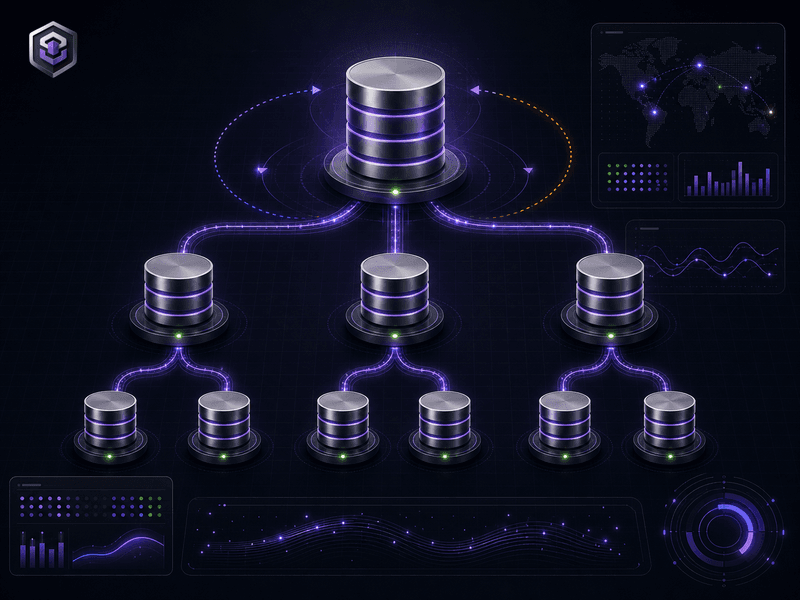
Topology Management
Advanced Topology Management
MySQL Orchestrator provides sophisticated tools for managing complex MySQL replication topologies.
Master-Slave Chains
Manage traditional master-slave replication chains with automatic failover capabilities.
Intermediate Masters
Support for intermediate masters to reduce replication load and improve performance.
Cross-DC Replication
Manage replication across multiple datacenters with network-aware policies.
Complete Orchestrator Suite
What MySQL Orchestrator services do you provide?
From initial deployment to advanced topology management, we provide end-to-end MySQL Orchestrator services to ensure optimal replication performance and reliability.
Orchestrator Deployment
Professional installation and configuration of MySQL Orchestrator for your replication environment.
Topology Discovery
Automatic discovery and visualization of your MySQL replication topology and relationships.
Failover Configuration
Configure automated failover policies and recovery procedures for high availability operations.
Monitoring & Analytics
Comprehensive monitoring of replication health, lag, and cluster performance metrics.
Multi-tier Management
Support for complex replication topologies including intermediate masters and cascading replicas.
24/7 Support
Round-the-clock monitoring and support for mission-critical MySQL Orchestrator deployments.
Orchestrator Capabilities
What is included in a MySQL Orchestrator Consulting engagement?
A MySQL Orchestrator Consulting engagement includes replication topology discovery and refactoring, automated failover policy design, anti-flapping and acknowledgement tuning, candidate-promotion rules, and cross-datacenter awareness. We codify failure-aware recovery so the right replica is promoted, repositioning the topology automatically and without flap loops.
How does MySQL Orchestrator scale?
Our MySQL Orchestrator implementations transform replication management and database reliability.
- 95%
- Failover Reduction
- <30s
- Recovery Time
- Real-time
- Topology Visibility
- <15m
- Response Time
Comparative Matrix · Replication Topology Management
How JusDB MySQL Orchestrator compares to alternative failover approaches.
MySQL Orchestrator delivers topology-aware failure detection and automated replica repointing using GTID or pseudo-GTID coordinates. Operating it safely across multi-datacenter topologies requires deep DBRE candidate weighting and STONITH fencing protocols. Here is how JusDB DBRE compares across critical replication vectors:
| Vector | JusDB | Cloud Native Default | Traditional Agency | In-House / DIY |
|---|---|---|---|---|
| Automated Topology Discovery via MySQL Performance Schema | Continuous non-intrusive topology polling via Performance Schema & replication metadata, building dynamic in-memory dependency graphs with zero query overhead. | Static replica registration within cloud provider control planes; unable to map or manage multi-tier intermediate replicas or cross-cloud topologies. | Periodic manual topology diagrams created in documentation tools; zero real-time awareness of replication breakage or cascaded replica trees. | Ad-hoc SHOW REPLICA STATUS queries executed manually during outages, leaving engineers blind to true replication tree structure. |
| Pseudo-GTID & Real GTID Crash Recovery & Sub-Tree Re-attachment | Native support for both MySQL GTID and Pseudo-GTID; automated sub-tree relocation and binlog coordinates matching to re-attach stranded replicas without rebuilding. | Inability to recover stranded sub-trees; failed replicas must be completely terminated and recreated from cloud snapshots. | Manual calculation of Relay_Master_Log_Pos and Exec_Master_Log_Pos, frequently causing duplicate transaction execution or broken replication. | Failed replicas abandoned or manually re-seeded with mysqldump, resulting in multi-hour recovery times and replica drift. |
| Zero-Data-Loss Master Promotions with Candidate Filtering | Configurable promotion rules with PromotionRule preferences, datacenter awareness, semi-sync validation, and automated fencing hooks to prevent split-brain. | Blind failover to whichever replica is designated by cloud zone priority, regardless of replication lag or transaction backlog. | Manual failover procedures requiring DBA judgment calls during high-stress production outages, risking selection of lagged replicas. | Scripted failovers without fencing or lag checking, promoting secondary nodes with thousands of missing transactions and causing silent data loss. |
| Web GUI & REST API Cluster Telemetry & Failure Visualization | Centralized Orchestrator Raft high-availability cluster with visual web GUI, granular REST API telemetry, Slack/PagerDuty hook integrations, and automated audit logging. | Basic cloud dashboard with limited replication metrics; no visual representation of intermediate masters or replication hierarchy. | No visualization tooling; relies on text emails and basic ping monitoring that misses replication thread stalls. | Standalone single-instance Orchestrator without Raft consensus, creating a single point of failure where the monitor itself crashes unnoticed. |
| Modernization Pathways from Openark Orchestrator to InnoDB Cluster | Phased modernization blueprint transitioning legacy async/Orchestrator estates to MySQL InnoDB Cluster and Group Replication with zero production downtime. | Advises complete forklift migration to proprietary cloud databases (Aurora) with massive refactoring and vendor lock-in costs. | Recommends leaving legacy async replication in place indefinitely due to fear of migration complexity, accumulating technical debt. | High-risk cutovers attempted without rollback runbooks, causing extended application outages and data reconciliation nightmares. |
| Contractual <15-Min Sev-1 Response SLA with Principal DBREs | Contractual <15-min Sev-1 response SLA with veteran DBREs, dedicated war room, automated failover verification drills, and comprehensive root-cause analysis. | Standard cloud ticketing with 1–4 hour response times from general infrastructure engineers with no deep MySQL replication expertise. | 2–8 hour response windows during regular business hours; no SLA commitments for emergency replication desync or data loss recovery. | Exhausted in-house engineers struggling to debug complex GTID state inconsistencies during overnight production emergencies. |
Information Gain · High-Consequence Orchestrator Edge Cases
MySQL Orchestrator: Critical Failure Modes
Asynchronous replication lag, network flapping, and uncoordinated promotions introduce subtle failure boundaries during master failures. Here are 3 mission-critical production failure modes our Principal DBRE team mitigates:
Flapping Master Network Triggering False Positive Failover
Intermittent network latency or brief packet loss between Orchestrator and the active primary causes premature detection of primary death. If an automated failover triggers while the primary is still servicing writes, clients experience split-brain divergence.
JusDB tunes FailureDetectionPeriodicIntervalSeconds, mandates multiple independent Orchestrator Raft observer quorum confirmations, and sets strict anti-flapping recovery cooldown limits.
Split-Brain Promotion Without Coordinated Fencing
Promoting a candidate replica without cryptographically or administratively fencing the demoted primary leaves both nodes writable, causing duplicate auto-increment IDs and irreversible transaction conflicts.
We enforce PreFailoverProcesses and PostMasterFailoverProcesses hooks executing automated STONITH fencing, read_only=ON locking, and dynamic proxy routing table updates.
Asynchronous Replication Lag Data Loss During Forced Promotion
Emergency failover to an asynchronous replica with significant Seconds_Behind_Master or unapplied relay logs discards uncommitted primary transactions, causing silent data loss.
JusDB configures semi-synchronous replication with rpl_semi_sync_master_wait_point=AFTER_SYNC, enforces promotion candidate filtering, and enables automated sub-tree re-attachment to salvage lagging transactions.
Our MySQL DBREs execute non-blocking diagnostics to query Orchestrator cluster topology, verify active primary designation, and audit replication hierarchy:
Extracts ASCII hierarchy tree of all registered database instances in the cluster, displaying active replication links, lag status, and binary log coordinates.
# 1. Output ASCII topology hierarchy for target cluster
orchestrator-client -c topology -i cluster1

# 2. Audit replication analysis to detect unhandled cluster failures
orchestrator-client -c replication-analysis
Queries Orchestrator to identify the designated master for a specific replica instance and verifies whether automated recovery is enabled.
# 1. Identify current master host for specified replica node
orchestrator-client -c which-master -i host1

# 2. Query cluster maintenance and auto-failover toggle status
orchestrator-client -c ack-cluster-recoveries -i cluster1
FAQ
MySQL Orchestrator failover & topology FAQs
Common questions about our MySQL Orchestrator services and replication management solutions.
Related MySQL Services
Explore Related MySQL Solutions
Orchestrator pairs naturally with our broader MySQL high availability and clustering services.
MySQL High Availability
Design resilient MySQL replication and failover architectures for near-zero downtime.
Explore MySQL High AvailabilityMySQL InnoDB Cluster
Build self-healing MySQL clusters with Group Replication and MySQL Shell automation.
Explore MySQL InnoDB ClusterReady to Master MySQL Replication with Orchestrator?
Get expert MySQL Orchestrator implementation from certified database professionals. We'll analyze your current MySQL replication setup and provide a detailed optimization plan with measurable reliability improvements.
Join the teams that trust JusDB for their MySQL Orchestrator and replication consulting needs.