Enterprise MySQL Clustering
MySQL InnoDBCluster Services
Deploy enterprise-grade MySQL InnoDB Cluster with Group Replication, MySQL Shell integration, and automatic failover for mission-critical applications.
MySQL InnoDB Cluster is Oracle's native high-availability database architecture combining Group Replication Paxos consensus, MySQL Shell AdminAPI automation, and MySQL Router proxying. It guarantees zero data loss (RPO=0) with sub-10-second automated failover across up to nine nodes. JusDB provides 24/7 DBRE management, quorum calibration, clone synchronization, and 15-minute Sev-1 SLAs.

Services
Comprehensive MySQL InnoDB Cluster Services
From initial setup to advanced optimization, we provide complete MySQL InnoDB Cluster solutions for enterprise environments.
InnoDB Cluster Implementation
Complete setup and configuration of MySQL InnoDB Cluster with Group Replication
- Cluster initialization and bootstrap
- Group Replication configuration
- Multi-primary and single-primary modes
- SSL/TLS encryption setup
MySQL Shell Integration
Advanced cluster management using MySQL Shell AdminAPI and automation
- AdminAPI cluster management
- Automated provisioning scripts
- Cluster status monitoring
- Node addition and removal
High Availability Setup
Enterprise-grade failover and disaster recovery with zero data loss
- Automatic failover detection
- Split-brain prevention
- Quorum-based decisions
- Cross-datacenter replication
Group Replication Optimization
Fine-tune Group Replication for optimal performance and consistency
- Conflict detection and resolution
- Flow control optimization
- Transaction certification
- Performance tuning
MySQL Router Integration
Seamless integration with MySQL Router for intelligent connection routing
- Automatic router configuration
- Read/write splitting setup
- Connection load balancing
- Failover transparency
Monitoring & Management
Comprehensive monitoring, alerting, and ongoing cluster management
- Performance metrics collection
- Health status monitoring
- Automated alerting setup
- 24/7 support and maintenance
Why InnoDB Cluster
Why Choose MySQL InnoDB Cluster?
MySQL InnoDB Cluster provides enterprise-grade high availability with native MySQL integration and zero data loss guarantees.
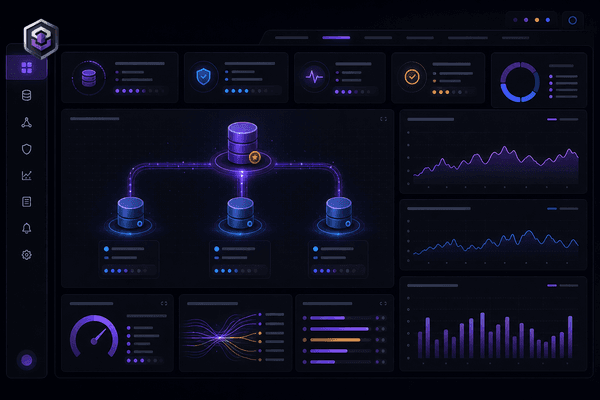
Native MySQL Integration
Built on MySQL Group Replication with seamless integration into existing MySQL environments and tooling.
Zero Data Loss
Synchronous replication ensures RPO=0 with automatic conflict detection and resolution for data consistency.
Automatic Failover
Intelligent failure detection with automatic primary election and transparent application failover.
MySQL Shell AdminAPI
Powerful administration interface for cluster management, monitoring, and automated operations.
Deployment Modes
InnoDB Cluster Deployment Modes
Choose the optimal cluster configuration for your application requirements and consistency needs.
Single-Primary Mode
One primary node handles all writes, secondaries serve reads
Ideal for applications requiring strong consistency with automatic primary election and seamless failover.
Multi-Primary Mode
All nodes accept writes with conflict detection and resolution
Perfect for geographically distributed applications requiring local write access with global consistency.
Process
Our InnoDB Cluster Implementation Process
A systematic approach to deploying production-ready MySQL InnoDB Cluster with comprehensive testing and validation.
Architecture Planning
Design cluster topology, analyze requirements, and plan deployment strategy for optimal performance.
Cluster Bootstrap
Initialize the cluster, configure Group Replication, and establish secure communication channels.
Integration & Testing
Configure MySQL Router, perform failover testing, and validate application compatibility.
Production Deployment
Deploy to production with monitoring, alerting, and comprehensive documentation and training.
Comparative Matrix · High Availability Architecture
How JusDB MySQL InnoDB Cluster compares to alternative architectures.
MySQL InnoDB Cluster unifies Group Replication, MySQL Shell AdminAPI, and MySQL Router into an integrated native clustering solution. Operating it under mission-critical enterprise workloads requires deep engine-level calibration rather than generic database administration. Here is how JusDB DBRE compares across critical HA vectors:
| Vector | JusDB | Cloud Native Default | Traditional Agency | In-House / DIY |
|---|---|---|---|---|
| Group Replication Paxos Consensus vs Asynchronous Replication | Distributed Paxos consensus with synchronous certification across up to 9 nodes, atomic state transitions, guaranteed zero split-brain, and RPO=0 zero data loss. | Multi-AZ asynchronous or semi-sync replication with loose binlog synchronization, DNS switchover lag (60–120s), and risk of split-brain under AZ partitions. | Legacy async primary-replica pairing with manual promotion scripts, single-threaded SQL applier threads prone to replication lag, and silent data drift. | Uncoordinated replication topologies lacking consensus; network blips trigger split-brain multi-writer scenarios and catastrophic data divergence. |
| MySQL Shell AdminAPI Automated Lifecycle & Provisioning | Programmatic cluster orchestration via MySQL Shell AdminAPI (dba.createCluster, cluster.addInstance), automated seed bootstrapping, and scriptable metadata schema validation. | Proprietary cloud console or CLI abstractions that conceal underlying cluster primitives, restrict AdminAPI execution, and enforce vendor lock-in. | Manual step-by-step CLI execution of CHANGE REPLICATION SOURCE commands with static configuration file edits and elevated human error risk. | Fragile custom bash scripts attempting to manage topology states, frequently breaking during version upgrades or online schema changes. |
| Single-Primary vs Multi-Primary Conflict Detection | Workload-calibrated deployment of Single-Primary mode with automatic election weighting or Multi-Primary mode with certification-based first-committer-wins conflict detection. | Restrictive single-writer topologies without multi-master certification tuning; unable to support active-active multi-datacenter write scenarios. | Advises against multi-master due to lack of certification engine understanding; fails to tune transaction retry logic or certification queue depths. | Arbitrary multi-master writes on standard async replication leading to duplicate key errors, foreign key violations, and corrupt transactional history. |
| MySQL Router Native Layer-7 Transparent Failover Integration | Native integration with MySQL Router dynamic metadata cache; sub-second TCP redirect on port 6446 (read-write) and 6447 (read-only) with zero application code modifications. | Cloud DNS record updates or generic network load balancers taking 30–90 seconds to re-route traffic, dropping active client connections abruptly. | Third-party proxy setups (HAProxy) requiring manual backend weight scripts that fail to detect non-primary read-only status changes. | Hardcoded application connection strings requiring rolling application container restarts and cache invalidations during any primary failure. |
| Automated Member Recovery & Clone Plugin Synchronization | Zero-downtime donor provisioning via MySQL Clone Plugin (donor/recipient state transfer) with automated fallback to binlog catch-up without taking donors offline. | Full disk snapshot restores or slow instance rebuilds that take hours for large datasets and incur hefty cross-AZ data transfer fees. | Manual mysqldump or logical export restores that lock production tables, consume massive server memory, and require maintenance windows. | Unverified manual rsync or physical file copying with stopped services, risking InnoDB tablespace corruption and extended downtime. |
| Contractual <15-Min Sev-1 Response SLA with Principal DBREs | Direct 24/7/365 access to named Principal DBREs via dedicated Slack war room, sub-15-minute Sev-1 contractual SLA, and post-incident root cause forensics. | Generic cloud support portals with tiered ticketing; 1–4 hour response times from generalist cloud support triage staff. | Tier-1 helpdesk ticketing with 2–8 hour response windows during standard business hours; no on-call emergency database specialists. | Single internal DBA or DevOps engineer on call, leading to alert fatigue, burnout, and unmonitored overnight cluster quorum collapse. |
Information Gain · High-Consequence InnoDB Cluster Edge Cases
MySQL InnoDB Cluster: Critical Failure Modes
Group Replication Paxos consensus and online state transfer introduce subtle failure boundaries under high concurrency and network degradation. Here are 3 mission-critical production failure modes our Principal DBRE team mitigates:
Network Partition Dropping Group Replication Quorum
Asymmetric network partitions isolate minority members. Without a strict majority quorum (>50% active voting members), the cluster enters a blocking state where transactions queue and fail to certify, halting application write traffic.
JusDB configures odd-numbered topologies (3 or 5 nodes), calibrates group_replication_unreachable_majority_timeout, and provides automated recovery scripts to force quorum or reconfigure group membership safely.
Unresolvable Transaction Conflict in Multi-Primary Mode
Concurrent write transactions modifying identical rows on different primary nodes fail certification. In multi-primary topologies, transaction abort cascades cause heavy rollback overhead, locking spikes, and application commit failures.
We calibrate group_replication_transaction_size_limit, enforce strict single-primary mode by default for OLTP workloads, and implement application-level partitioning with optimistic locking retry logic.
Clone Plugin State Transfer Timeout Freezing Joiner
When a new or recovering instance joins, physical state transfer via Clone Plugin can experience network socket timeouts or disk saturation during donor copy, leaving the joiner node stranded in RECOVERING state.
We optimize clone_buffer_size, tune clone_max_concurrency, provision dedicated recovery network interfaces, and configure automatic fallback to incremental binlog state transfer.
Our MySQL DBREs execute non-blocking diagnostics to inspect cluster topology health, member roles, quorum status, and replication certification queues:
Inspects real-time cluster quorum, member health, role assignments (PRIMARY/SECONDARY), and topology fence states via MySQL Shell.
// 1. Connect to any cluster instance via MySQL Shell
mysqlsh root@10.0.1.10:3306 --js

// 2. Retrieve cluster handle and evaluate topology status
var cluster = dba.getCluster();
cluster.status({extended: 1});

// 3. Verify transaction certification and flow control metrics
cluster.describe();Audits active group replication members, communication protocol version, queue backlog depths, and detected conflicts.
-- 1. Inspect MySQL Group Replication member states & roles
SELECT
  member_id,
  member_host,
  member_port,
  member_state,
  member_role,
  member_version
FROM performance_schema.replication_group_members;

-- 2. Audit certification queue depth, conflicts, and transaction lag
SELECT
  channel_name,
  count_transactions_in_queue,
  count_transactions_checked,
  count_conflicts_detected,
  count_transactions_rows_validating
FROM performance_schema.replication_group_member_stats;
InnoDB Cluster & Group Replication FAQs
Common questions about MySQL InnoDB Cluster implementation and Group Replication.
Related MySQL Services
Explore complementary MySQL high availability and clustering solutions that pair with InnoDB Cluster.
MySQL High Availability
End-to-end MySQL high availability architectures with automatic failover and zero downtime.
MySQL Router
Transparent connection routing, read/write splitting, and failover with MySQL Router.
MySQL Orchestrator
Topology management and automated failover for MySQL replication with Orchestrator.
Ready to Deploy Enterprise MySQL Clustering?
Let our experts implement MySQL InnoDB Cluster for your mission-critical applications with zero data loss guarantees.